The right AC system for a humid climate does two jobs simultaneously — it removes heat and actively dehumidifies your air. Most generic buying guides stop at cooling capacity. We don't. In our experience, it's the latent heat removal specs, variable-speed compressor behavior, and SEER2 ratings under real humidity loads that separate a comfortable home from one that never quite feels right, no matter how low you set the thermostat.
This guide covers which system types hold up in high-humidity conditions, the technical specifications that actually matter, and the mistakes we see homeowners make most often when they shop on cooling power alone. Use it to make a confident, informed decision that protects your family's comfort — and your equipment — for years to come.
TL;DR Quick Answers
Replacing Home AC Unit
Replacing a home AC unit means removing the old system and installing new equipment sized and matched to your home's specific cooling and humidity loads. Here is what matters most:
When to replace: System is 15+ years old, repairs are frequent, or costs exceed 50 percent of new system price
What it costs: Most homeowners spend between $5,000 and $12,000 for full system replacement including installation
What size you need: Determined by a Manual J load calculation — not square footage guesswork
What to replace: Both indoor and outdoor units together — mismatched components reduce efficiency and void warranties
How long it lasts: 15 to 20 years with annual tune-ups, consistent filter changes, and indoor humidity kept between 30 and 50 percent
What most guides miss: In a high-humidity climate, the system that dehumidifies best beats the system with the highest cooling capacity — every time
The most important question to ask your contractor: Will you perform a Manual J load calculation before recommending equipment? If the answer is no, keep looking.
Top Takeaways
Humidity control is the real job. Cooling alone isn't enough. The right system removes moisture and heat — on every cycle, all season long.
Runtime beats raw power. Variable-speed and two-stage systems run longer at lower capacity. That extended runtime is what pulls moisture out. Short-cycling is what prevents it.
Shop by the right specs. SEER2 alone doesn't tell the full story in a humid climate. Prioritize Sensible Heat Ratio and EER2 — these reveal how a system performs when heat and humidity hit at the same time.
Oversizing is the most preventable mistake. Too large means too fast. The system cools quickly, short-cycles, and never dehumidifies. Always require a Manual J load calculation before any equipment is specified.
Know the EPA standard your system should meet. Indoor humidity should stay between 30 and 50 percent. Above 60 percent, mold grows. A properly sized and installed AC system is the primary tool that keeps your home in the safe range.
Why Standard AC Systems Struggle in High-Humidity Climates
Most AC systems are engineered to remove heat — not humidity. In dry climates, that's enough. In humid ones, it isn't. Here's why: an AC system removes moisture as a byproduct of cooling, but only when it runs long enough for condensation to form on the evaporator coil. Oversized systems — one of the most common installation mistakes we see — short-cycle through their cooling cycles too quickly to pull meaningful moisture out of the air. The result is a home that feels cool for a few minutes, then clammy again within the hour.
Humidity isn't just a comfort issue. Excess indoor moisture accelerates mold growth, degrades indoor air quality, strains your equipment, and drives up energy costs. In our experience servicing homes across high-humidity regions, moisture management is the single most overlooked factor in selecting the best AC replacement system.
The Best AC System Types for Humid Climates
Not every system handles humidity equally. These are the options that consistently perform best in high-moisture environments.
Two-Stage and Variable-Speed Central Air Conditioners
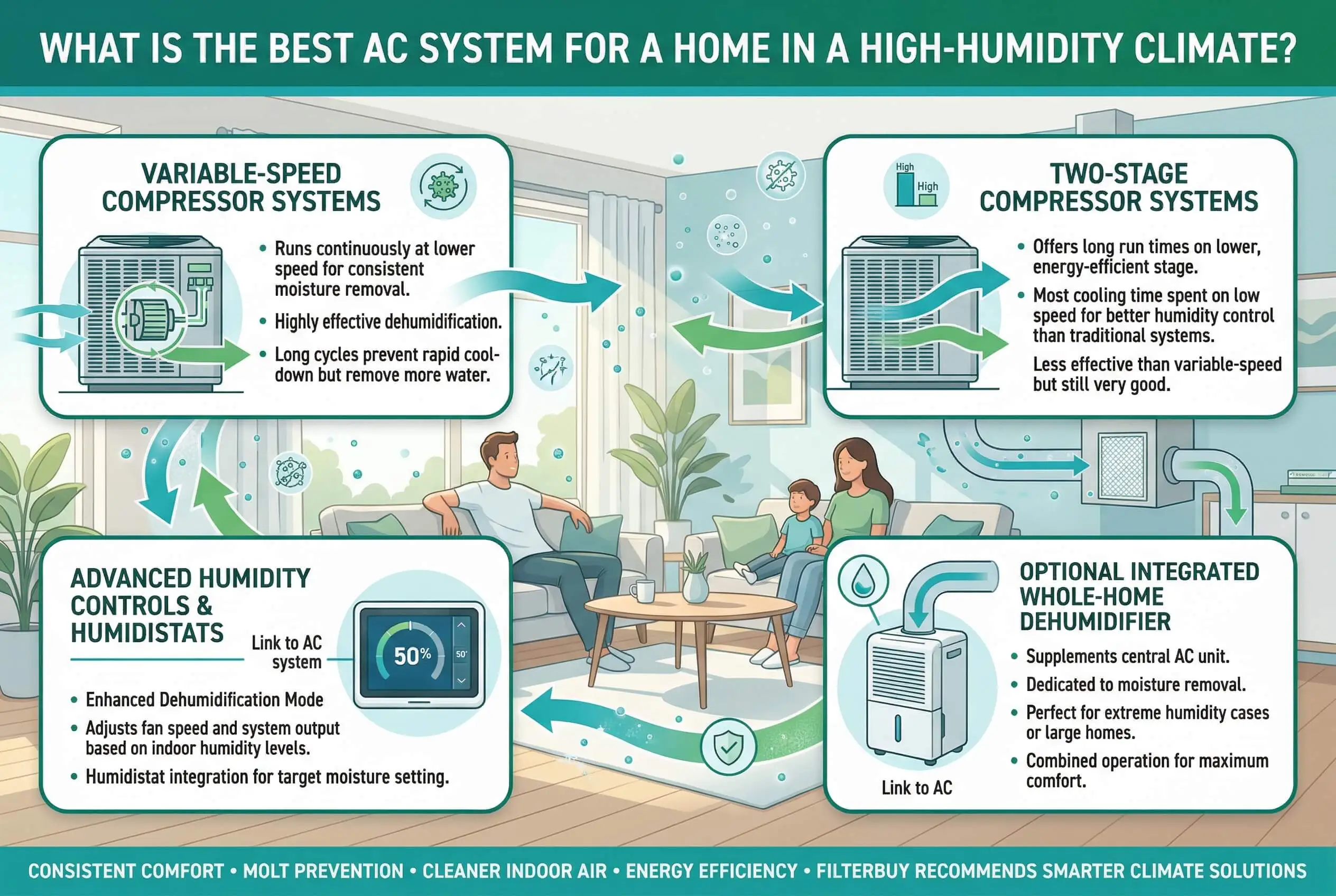
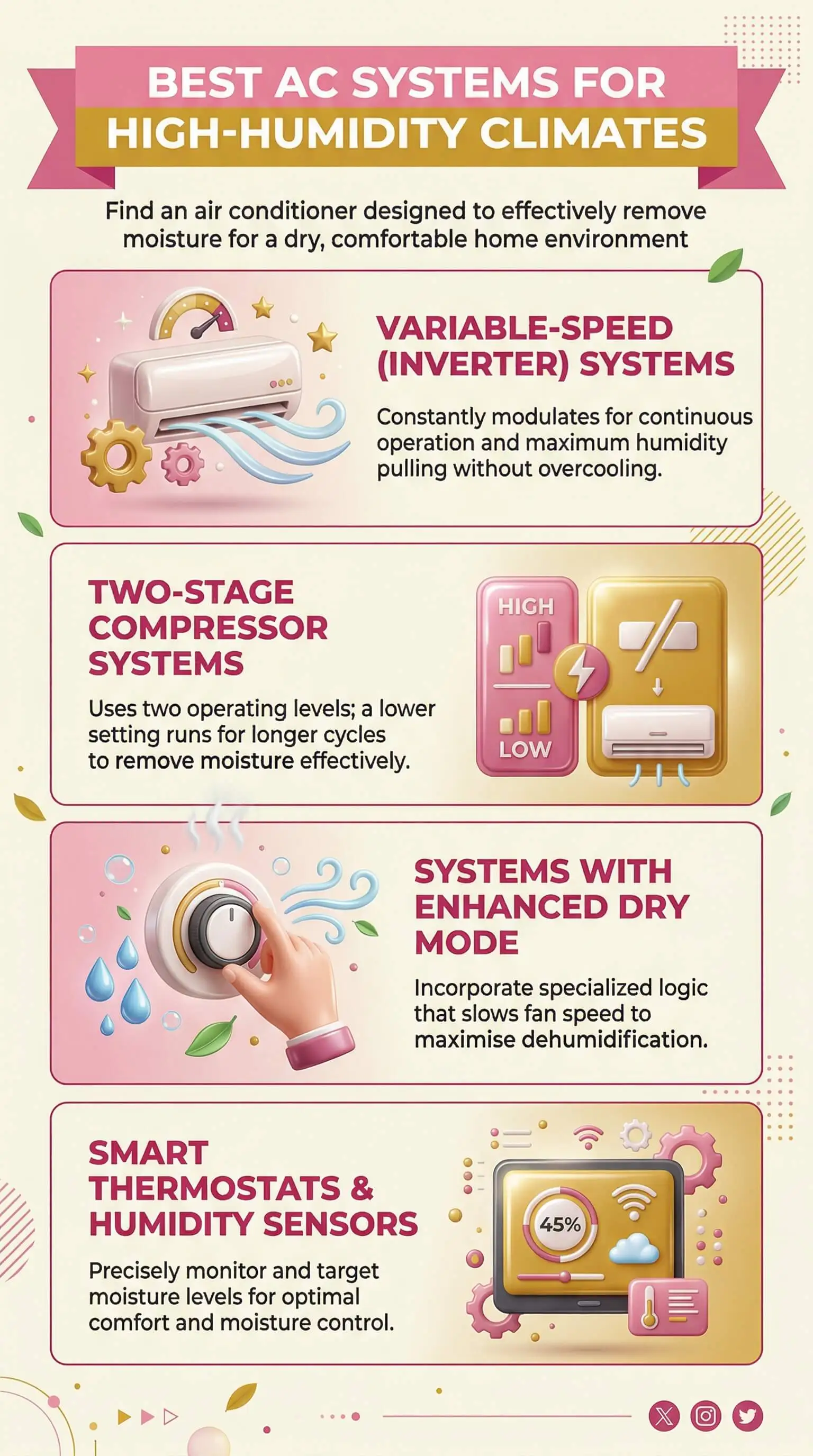
Variable-speed and two-stage central AC systems are the gold standard for humid climates. Unlike single-stage systems that run at full blast or not at all, variable-speed compressors modulate output continuously — running longer at lower capacity rather than cycling on and off. That extended runtime is exactly what pulls moisture out of the air efficiently.
In our experience, homes in humid climates that upgrade from single-stage to variable-speed systems often report dramatic improvements in comfort without any significant drop in the thermostat setting. The air simply feels drier, cleaner, and more breathable.
Heat Pumps With Humidity Control
Modern heat pumps — particularly those with variable-speed inverter technology — rival the best central AC systems in humid conditions. They're uniquely efficient because they transfer heat rather than generate it, and newer models include dedicated dehumidification modes that maintain moisture control even when the home doesn't need additional cooling. For homeowners in mixed-humid and hot-humid climates, a properly sized inverter-driven heat pump is one of the most effective all-around solutions available today.
Dedicated Whole-Home Dehumidifiers Paired With Central AC
For homes where the existing AC system is otherwise functioning well, a whole-home dehumidifier integrated into the ductwork is often the most cost-effective upgrade. These units work independently of the cooling cycle, maintaining target humidity levels regardless of whether the AC is actively running. We frequently recommend this pairing for homeowners who have recently replaced their AC and don't want to reinvest in a new system — it's one of the most impactful improvements for the cost.
The Specifications That Matter Most in Humid Climates
Shopping by SEER2 rating alone will not get you the right system for a humid home. These are the specs to prioritize.
Sensible Heat Ratio
Sensible Heat Ratio (SHR) measures the proportion of an AC system's cooling capacity devoted to temperature reduction versus moisture removal. A lower SHR means more dehumidification capacity. For humid climates, look for systems with an SHR below 0.75. Most manufacturers list this in their engineering specifications — if a contractor can't discuss it, that's worth noting.
EER2 Rating Under Real Load Conditions
Energy Efficiency Ratio 2 (EER2) measures efficiency at a fixed high-temperature condition and better reflects real-world performance in hot, humid summers than SEER2 alone. A system with a strong SEER2 but a weak EER2 may underperform precisely when humidity loads are heaviest. Look for both numbers together.
Proper System Sizing
Correct Manual J load calculation — the industry standard for sizing HVAC equipment — is non-negotiable in humid climates. Oversizing is the most preventable mistake we see, and it directly undermines moisture control. A properly sized system runs longer cycles at appropriate capacity, removes more moisture, and extends equipment life. Insist on a load calculation before any system is specified.
What to Ask Your HVAC Contractor
The right system is only as good as the installation behind it. Before committing to any equipment, ask your contractor these questions:
Are you performing a Manual J load calculation for my home?
What is the Sensible Heat Ratio on the systems you're recommending?
Does this system include a variable-speed or two-stage compressor?
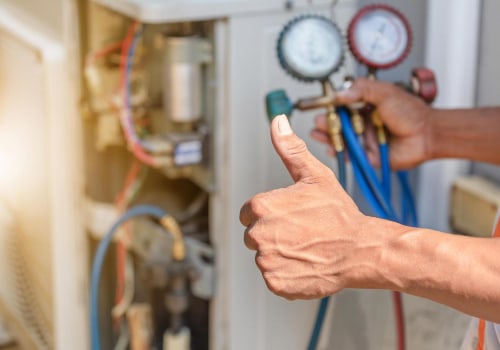
How will you verify that the refrigerant charge and airflow are set correctly after installation?
In our experience, contractors who can answer these questions directly — without hesitation — are the ones most likely to get the installation right.
"Most homeowners shopping for a new AC system in a humid climate focus almost entirely on cooling capacity — and that's exactly where the decision goes wrong. After servicing systems across some of the most humidity-challenged homes in the country, the pattern we see most often is straightforward: an oversized, single-stage unit that short-cycles through its runtime without ever pulling meaningful moisture out of the air. The home cools down, but it never dries out. What we've learned is that in a humid climate, runtime is everything. A variable-speed system that runs longer at a lower stage will outperform a high-capacity single-stage unit every time — not because it's more powerful, but because it stays on long enough to do the dehumidification work that single-stage systems simply skip. Comfort in a humid home isn't just about temperature. It's about the moisture your system removes on every single cycle."
Essential Resources
Replacing an AC system is one of the bigger decisions a homeowner makes. Get it right and you're comfortable for 15 to 20 years. Get it wrong and you're paying to fix it. These seven resources help you go in informed — covering what efficiency specs actually matter, how to vet your contractor, which tax credits you can claim, and what the refrigerant changes mean for your new system.
1. Cut Cooling Costs in Half With the Right AC Upgrade
Most homeowners don't realize how much the right system can reduce energy bills. The U.S. Department of Energy's home upgrades hub breaks down how high-efficiency AC and heat pump systems can cut cooling costs by up to 50%. It also shows what federal credits and local rebates are available in your area. https://www.energy.gov/save/home-upgrades
2. Claim Up to $600 Back on a New Central Air Conditioner
There's money available for homeowners who replace them with a qualifying system. But not every unit qualifies. ENERGY STAR's tax credit page lists the exact SEER2 and EER2 ratings your new AC needs to hit before you can claim the federal Energy Efficient Home Improvement Credit. Check this before you buy. https://www.energystar.gov/about/federal-tax-credits/central-air-conditioners
3. Earn Up to $2,000 Back If You Choose a Heat Pump Instead
A heat pump does the job of both an AC and a heating system. It also qualifies for a larger tax credit — up to $2,000. ENERGY STAR's heat pump credit page covers which systems qualify today, including both ducted and ductless options. Worth reviewing if you're replacing an older system and want to maximize your investment. https://www.energystar.gov/about/federal-tax-credits/air-source-heat-pumps
4. How to File for Your HVAC Tax Credit With the IRS
Knowing you qualify is one thing. Filing correctly is another. The IRS Energy Efficient Home Improvement Credit page walks through Form 5695, 2025 manufacturer ID requirements, and how annual credit limits work. Read this before tax season — not after. https://www.irs.gov/credits-deductions/energy-efficient-home-improvement-credit
5. What the Refrigerant Phaseout Means for Your New AC System
New AC systems no longer use R-410A. As of January 1, 2025, manufacturers have transitioned to lower-GWP refrigerants like R-454B and R-32 under EPA's AIM Act mandate. This matters for long-term service costs and parts availability. The EPA's AIM Act hub explains what changed and why. https://www.epa.gov/climate-hfcs-reduction
6. Plain-Language Answers to Your Refrigerant Regulation Questions
Refrigerant regulations are confusing. The EPA's HFC phasedown FAQ page clears it up in plain terms — what happens to your existing system, how new refrigerants perform, and what the rules are for replacements done today. A quick read that answers most of the questions homeowners ask us. https://www.epa.gov/climate-hfcs-reduction/frequent-questions-phasedown-hydrofluorocarbons
7. The Contractor Checklist That Protects You Before You Sign Anything
A proper AC installation starts with a proper load calculation. It doesn't end there. ENERGY STAR's HVAC Quality Installation bid sheet gives you the exact questions to ask any contractor before work begins — including Manual J sizing, duct leakage testing, and matched equipment verification. If a contractor hesitates on any of these, that tells you something. Use this checklist on every quote. https://www.energystar.gov/sites/default/files/asset/document/HVAC_QI_bidsheet.pdf
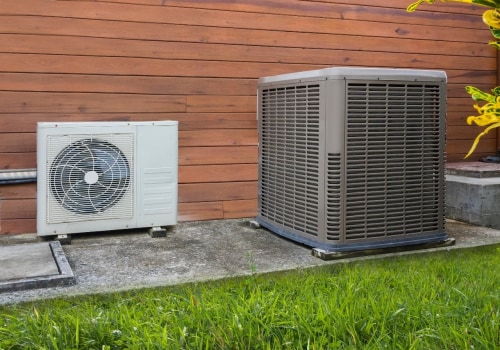
These essential resources help homeowners make smarter AC replacement decisions by understanding efficiency ratings, tax credits, refrigerant changes, contractor standards, and how the AC condenser fits into long-term system performance and comfort.
Supporting Statistics
The data on AC performance in humid climates is clear. Homeowners who understand it make better decisions — and avoid the most expensive mistakes.
In the hot-humid region, air conditioning accounts for 27% of total home energy expenditures — more than double the national average.
National average annual AC cost: $265
Hot-humid Southeast average annual AC cost: $525
That gap reflects moisture load, not just heat
A system not built for humidity costs more every month it runs
Choosing the right system from the start is one of the most impactful financial decisions a homeowner in a humid climate can make.
Source: U.S. Energy Information Administration, Residential Energy Consumption Survey https://www.eia.gov/todayinenergy/detail.php?id=36692
Switching to a high-efficiency AC system can reduce home cooling energy use by 20 to 50 percent.
The U.S. Department of Energy confirms high-efficiency systems can cut cooling energy by up to half
In the hot-humid South, AC already represents more than a quarter of total home energy spending
That efficiency gain translates directly into hundreds of dollars in annual savings
System efficiency specs matter as much as upfront equipment cost
Source: U.S. Department of Energy, Air Conditioning Energy Saver https://www.energy.gov/energysaver/air-conditioning
The EPA recommends keeping indoor relative humidity between 30 and 50 percent — and warns that levels above 60 percent create conditions for mold growth.
Indoor humidity above 60% creates conditions for mold to grow and spread
AC systems that short-cycle are a leading contributor to elevated indoor humidity
Undersized and oversized systems both fail to complete full dehumidification runs
In our experience, most homeowners don't connect mold to their AC until the damage is already visible
Source: U.S. Environmental Protection Agency, Mold Course Chapter 2 https://www.epa.gov/mold/mold-course-chapter-2
Final Thoughts
Choosing the best AC system for a high-humidity climate comes down to one priority most buying guides never state plainly: humidity control is the job. Cooling is just how the system does it. Get that backwards and no efficiency rating or brand name will save you from a home that never feels comfortable.
What This Page Covered
Single-stage systems short-cycle in humid climates — they cool without fully dehumidifying
Variable-speed and two-stage systems run longer at lower capacity, removing more moisture per cycle
Heat pumps with inverter technology are among the strongest performers in humid conditions
Sensible Heat Ratio and EER2 are the specs that separate a humidity-capable system from one that isn't
Oversizing is the most preventable installation mistake — and the most common one we see
A Manual J load calculation is non-negotiable before any system is specified
The right contractor answers technical questions directly and without hesitation
Our Opinion
After servicing AC systems across some of the most humidity-challenged homes in the country, our honest take is this:
The AC industry has a marketing problem that costs homeowners real money. Cooling capacity sells systems. Humidity performance doesn't.
Here is what gets overlooked most often:
Homeowners in humid climates are sold on BTUs and SEER ratings
The questions that actually matter — runtime behavior, Sensible Heat Ratio, shoulder-season performance — rarely come up at the point of sale
Spring and fall are when a poorly matched system shows its weaknesses fastest
Those are also the conditions most contractors never mention before you sign
Our position is straightforward. In a humid climate, the best AC system is not the most powerful one. It's the one that runs longest, dehumidifies most consistently, and was sized by someone who measured your home before recommending equipment. Everything else is noise.
FAQ on Replacing Home AC Unit
Q: How do I know when it's time to replace my home AC unit rather than repair it?
A: Age and repair frequency tell most of the story. Systems 15 years or older that need repeated service calls are past the point where repairs make financial sense.
Replace instead of repair when:
The system uses R-22 or R-410A refrigerant — both increasingly costly to source
Indoor temperatures and humidity levels are no longer consistent
Repair costs are at or above 50 percent of new system cost
Breakdowns are happening more than once per cooling season
When repair costs reach 50 percent of replacement cost, replacement wins on total cost over time. Repairs buy time. The right replacement buys 15 to 20 years.
Q: How much does it cost to replace a home AC unit?
A: Most homeowners should budget between $5,000 and $12,000 for a full central AC system replacement, including equipment and installation.
What moves that number:
System type — heat pumps cost more upfront but qualify for federal tax credits up to $2,000
Home size and local labor rates
Efficiency rating and equipment tier
What to keep in mind before focusing on the lowest bid:
An undersized or poorly installed system runs harder and fails sooner
In humid climates, a cheap installation almost always costs more over time
The equipment price matters less than getting the installation right
Q: What size AC unit does my home need?
A: There is no reliable shortcut. Proper sizing requires a Manual J load calculation — the ANSI-recognized industry standard required by most residential building codes.
A Manual J accounts for:
Square footage and ceiling height
Insulation levels and window area
Local climate conditions and humidity loads
Duct configuration and airflow capacity
What happens without it:
Oversized systems short-cycle and fail to dehumidify
Undersized systems run continuously and wear out faster
Both outcomes raise energy costs and shorten equipment life
If a contractor won't perform a Manual J calculation, find one who will.
Q: Can I replace just the outdoor AC unit without replacing the indoor unit?
A: It is possible. It is rarely the right call.
Outdoor and indoor units are matched systems. Mismatching them causes three consistent problems:
Reduced efficiency — mismatched components raise monthly energy costs
Voided warranties — manufacturers require matched systems for coverage
Refrigerant incompatibility — systems built after January 1, 2025 use R-454B or R-32, which are not compatible with older indoor components
Replacing both units together costs more upfront. It almost always costs less over the life of the system.
Q: How long does a new home AC unit last?
A: A properly sized, correctly installed, and regularly maintained central AC system lasts between 15 and 20 years.
In high-humidity climates, lifespan depends on moisture management from day one.
What extends system life most reliably:
Annual professional tune-ups — coils, drain pans, and refrigerant charge inspected every season
Consistent filter changes — dirty filters restrict airflow and accelerate component wear
Indoor humidity held between 30 and 50 percent — excess moisture degrades components faster than almost anything else
The homeowners who get 20 years out of a system treat maintenance as routine. Not optional.
Ready to Find the Best AC System for Your High-Humidity Home?
Stop guessing and start with a system built for the climate you actually live in. Contact Filterbuy HVAC Solutions today for a no-pressure consultation and let our local experts match your home to the right equipment — the first time.
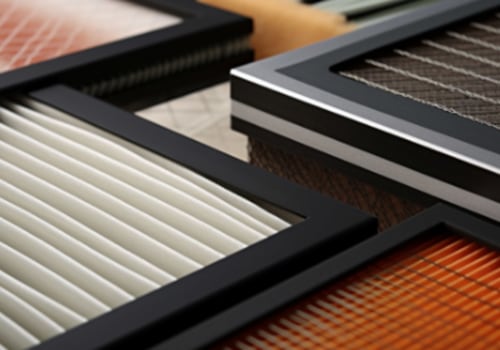
When evaluating What Is the Best AC System for a Home in a High-Humidity Climate?, it helps to remember that even the best-performing AC system still depends on proper airflow and filtration to manage comfort in damp conditions. Products like 20x24x1 MERV 8 air filter, 17x20x1 MERV 8 HVAC air filter, and 18x18x4 MERV 13 air filter are relevant because they highlight the filter sizes and MERV ratings homeowners may want to consider when pairing a replacement system with better indoor air quality and more reliable moisture control.