That quarter-inch of tape is where most indoor air quality plans quietly fall apart. Custom air filters are not a sizing workaround. They are the foundation layer of a real IAQ strategy, and a properly fitted filter is what gives every other investment, from ventilation to purifiers to humidity control, something solid to build on.
This page walks through how custom air filters fit into a broader indoor air quality plan, when off-the-shelf sizes fall short, how to match MERV to your household, and how to set a replacement cadence that actually holds up.
TL;DR Quick Answers
Custom Air Filters
Custom air filters are HVAC filters manufactured to the exact dimensions of your return or media cabinet, built to order so they seal the slot with zero bypass gaps and deliver the full MERV rating you paid for.
Why they matter: A filter that doesn't fit the slot lets unfiltered air slip around the edges, which means dust loads directly onto the coil and the MERV rating is only working on a fraction of the airflow.
Who needs them: Homeowners with older returns (pre-1990 construction), post-renovation cavities, or thick media cabinets built for four-inch or five-inch filters.
How to size one: Measure the slot opening itself (not the old filter) to the nearest eighth of an inch for length and width, and round depth to the nearest inch.
Recommended MERV: MERV 13 where the system supports it, per EPA guidance. Drop to MERV 11 for older blowers.
Replacement cadence: 90 days for one-inch filters, 60 days with pets, 30 days during pollen or wildfire smoke events. Four-inch and five-inch media filters run six months to a year.
Cost difference: Usually one to two dollars more per filter than standard sizes, recovered inside the first billing cycle through lower HVAC energy draw.
Bottom line: a custom air filter is the foundation layer of any indoor air quality plan. Every purifier, monitor, and humidity adjustment works harder on top of a filter that actually fits.
Top Takeaways
Filtration is the foundation layer of any indoor air quality plan. Everything else works better on top of a properly fitted filter.
Off-the-shelf sizes fall short in older homes, post-renovation systems, and thick media slots. A taped or wedged filter creates bypass air and dust-loads the coil.
MERV 8 covers basic dust. MERV 11 handles pets and allergens. MERV 13 is the EPA-recommended target for meaningful particle control when the system supports it.
A one-inch custom filter typically runs 90 days, tightening to 60 with pets and 30 during pollen or wildfire events. Four-inch media filters can go six months to a year.
The Department of Energy estimates that replacing a dirty filter can cut HVAC energy use by 5 to 15 percent.
A custom-sized filter is the only version of a MERV rating that actually delivers what the rating promises, because bypassing air around a mismatched frame defeats higher filtration.
Why a Custom Air Filter Is the Foundation of an IAQ Plan
Indoor air quality planning usually gets framed as a stack of upgrades: a purifier for the bedroom, a dehumidifier for the hall closet, a smart monitor somewhere near the thermostat. Those are all useful. None of them work the way you think they will if the filter in your HVAC return is the wrong size or the wrong rating for the household.
The reason is mechanical. An air filter inside an HVAC system is the one component that touches every cubic foot of conditioned air before it reaches a bedroom, a living room, or a nursery. A purifier only cleans the room it sits in. A filter in your return cleans the entire home, every time the system cycles on. When the filter fits the slot with no gaps and carries the right MERV rating for your household, it quietly does the heaviest lifting of any IAQ investment you will make.
That is why filtration sits at the base of the stack. Everything else you layer on top only works as well as the air conditioner filter and the air that is already circulating through your ducts.
When Off-the-Shelf Sizes Fall Short
Three situations come up again and again in the field where a standard size will not cut it:
Older homes. Return openings from the 1960s through the 1980s were often framed to the nearest convenient dimension, not to a filter standard. A 17 by 24, a 19 by 22, or a 15 by 25 are common.
Post-renovation systems. When a homeowner adds a room, converts a garage, or upgrades the air handler, the original return often gets modified. The new cavity rarely matches a standard filter.
Thick media slots. Media cabinets designed for four-inch or five-inch filters (16x25x5, 20x25x5, and similar) are not something you pick up at a big-box store. They require a manufacturer who actually builds to order.
A loose filter is worse than no filter. When unfiltered air bypasses the media around the edges, dust loads directly onto the evaporator coil. The coil loses efficiency, the blower works harder, and the system pulls more amps to move less conditioned air. Taping a filter in place is a short-term fix that creates three long-term problems.
Matching MERV to Your Indoor Air Quality Goals
MERV, or Minimum Efficiency Reporting Value, is the ASHRAE standard that tells you what size particles a filter can capture. The higher the number, the smaller the particle. For residential systems, the practical range is MERV 8 through MERV 13.
MERV 8. Dust, pollen, lint, and pet dander. A solid default for households without allergies or pets.
MERV 11. Everything MERV 8 catches, plus fine pet dander, mold spores, and smaller allergens. A good choice for homes with pets or allergy sufferers.
MERV 13. Everything above, plus smoke, bacteria, and particles down to 0.3 microns. EPA recommends MERV 13 or higher when system capacity allows, especially during wildfire events or in homes with respiratory-sensitive residents.
MERV selection is where sizing and filtration strategy meet. A MERV 13 filter cut to the wrong dimensions still leaks bypass air around the frame, which means the particles you picked that rating to catch are circulating right past it. This is where custom air filters earn their place. A filter built to the exact dimensions of the return, at the MERV level the household actually needs, is the only version of this that delivers what the rating promises.
One practical note on tradeoffs. Higher MERV ratings create more static pressure on the blower. Most residential systems handle MERV 11 and MERV 13 fine, but if the filter is thin (one inch) and the airflow is already restricted, a jump from MERV 8 to MERV 13 can strain the fan motor. Thicker media, four or five inches, solves this by spreading the same filtration load over a larger surface area.
How Custom Filters Interact With Other IAQ Layers
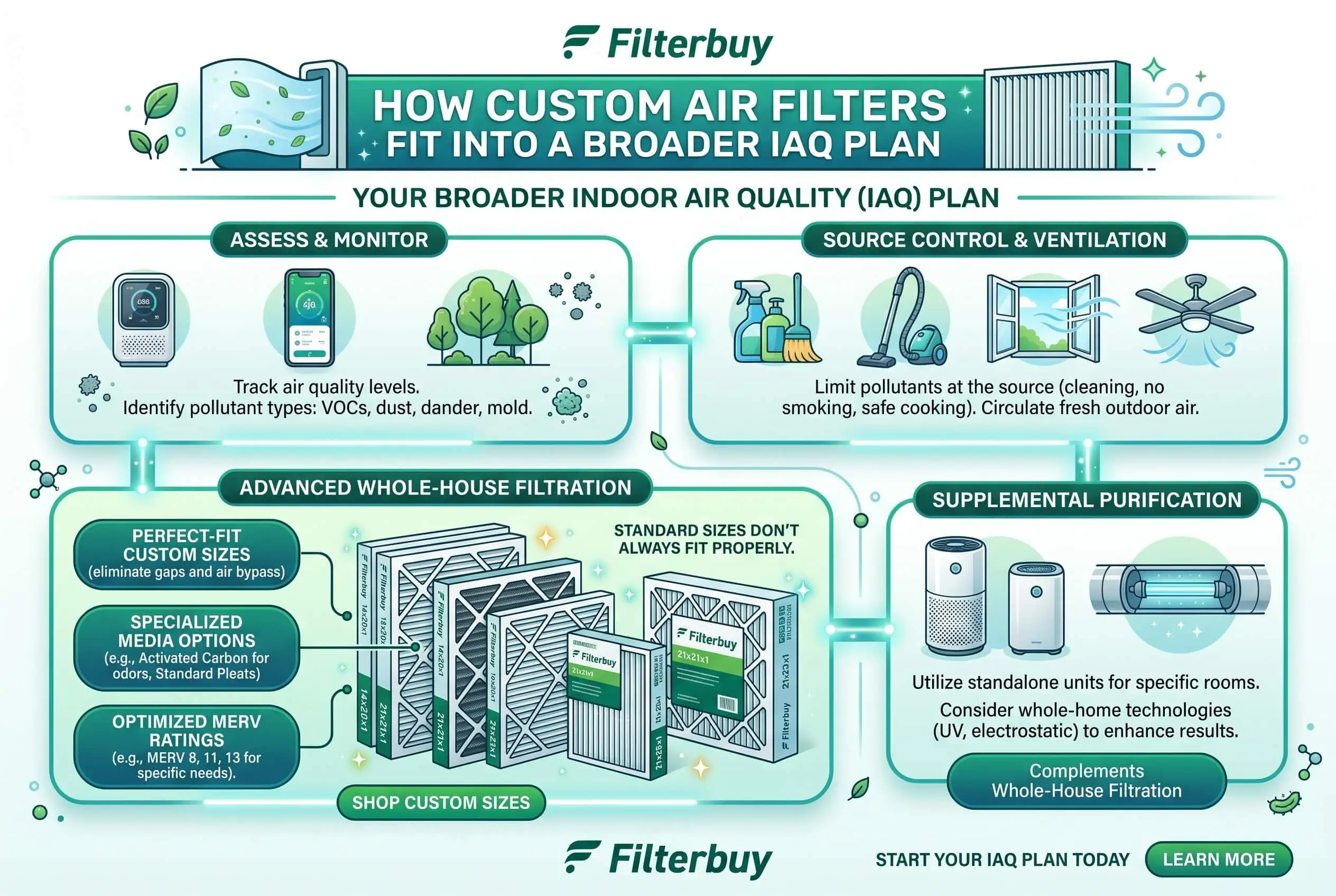
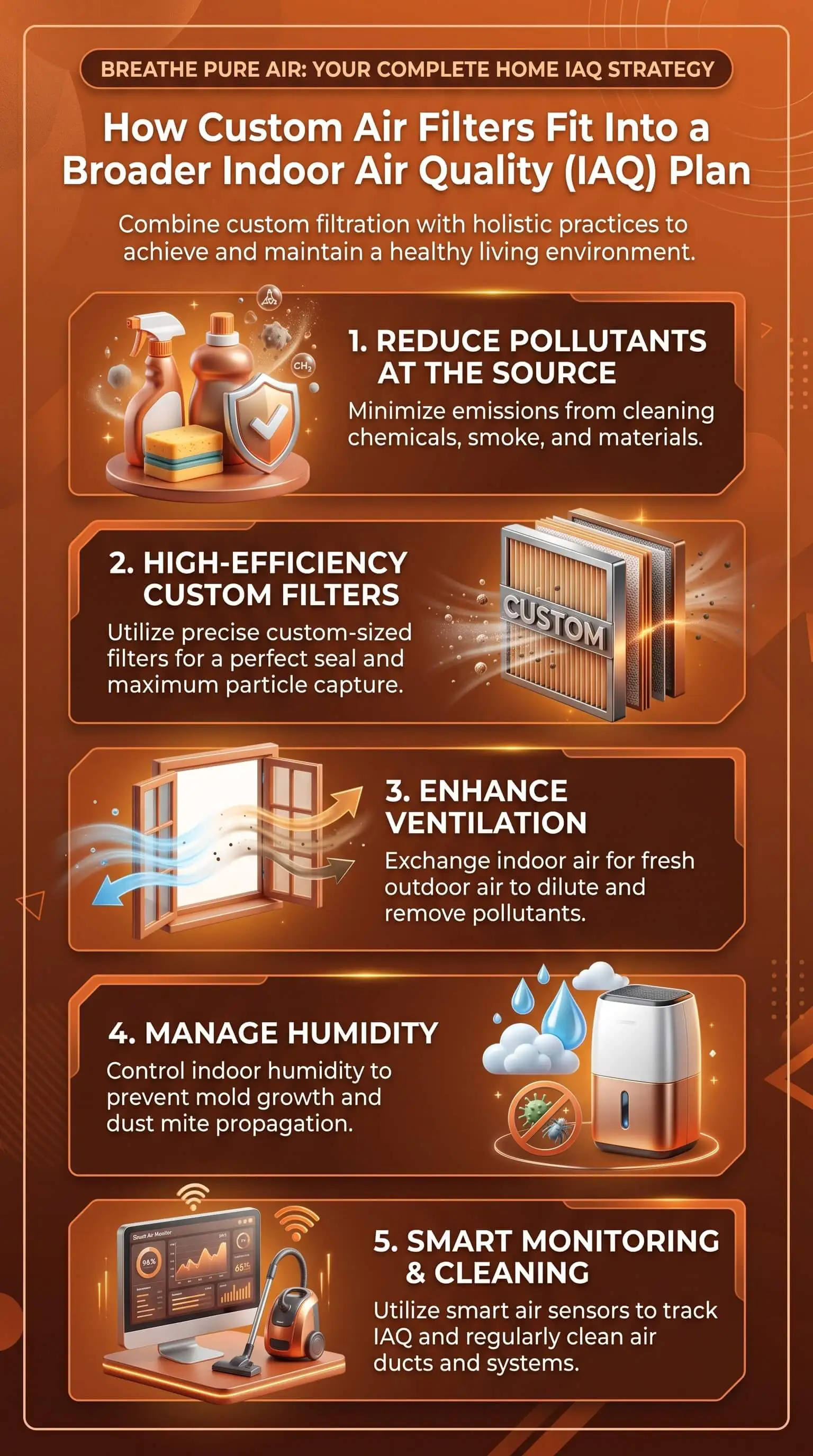
A complete indoor air quality plan has five layers: filtration, ventilation, source control, humidity management, and monitoring. Custom filtration makes every layer above it work harder for you.
Ventilation. Fresh air exchange only helps if the air circulating in the home is clean to start with. A properly fitted filter means the ventilation is diluting cleaner air, not spreading bypass dust.
Source control. Removing the source of a pollutant (stored chemicals, smoking, off-gassing furniture) is always the first move. A filter then cleans up what escapes.
Humidity. Florida humidity changes everything. Filters loaded with moisture lose efficiency, so pairing the right filter with a 30 to 50 percent humidity target keeps both working.
Monitoring. An air quality sensor only tells you what you are breathing. The filter determines what gets out.
Filtration is the always-on layer, which is why it plays such an important role in indoor air quality testing. Purifiers and sensors can be switched off. The return filter runs every time the HVAC cycles, which in a Florida summer is roughly half the day.
Replacement Cadence for a Custom-Sized Filter
A one-inch custom filter in a standard household runs about 90 days. The intervals tighten fast based on conditions:
60 days with pets or moderate allergies.
30 days during heavy pollen season or active wildfire smoke events.
30 to 45 days in homes with ongoing renovation dust.
Six months to a year for four-inch or five-inch media filters, depending on household load.
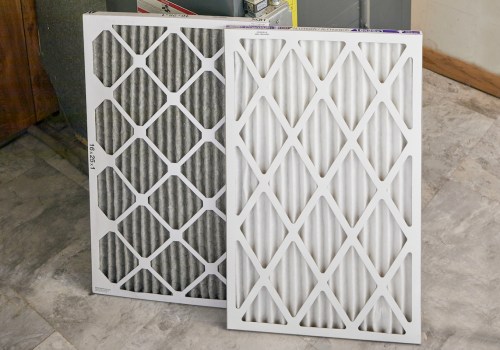
A loaded filter is easy to spot. The pleats go from light gray to deep gray, and the back side of the media shows a shadow of the airflow pattern. If a filter feels heavier than a fresh one and the return register pulls a piece of paper against the grille with noticeably less force, it is past due.
“In our experience across South Florida homes, the fastest quality-of-air improvement we see is not a new purifier or a smart thermostat. It is a filter that actually fits the slot. A quarter-inch gap around the frame will unravel almost any IAQ plan you build on top of it, and we have walked into plenty of houses where a MERV 13 purchase was doing the work of a MERV 6 because the filter was floating in the return.”
7 Essential Resources
The resources below are the ones our team returns to when we are helping a homeowner think through an IAQ plan from scratch. Each one is sourced from a government agency or a major nonprofit, and each link points to a unique page.
1. EPA Overview of Indoor Air Quality and Why It Matters
The EPA's main IAQ hub is the clearest entry point for anyone who wants to understand what indoor air pollution actually is, where it comes from, and what levels of risk it carries. It is the agency's consumer-facing framework for everything else.
Source: U.S. Environmental Protection Agency - Indoor Air Quality (IAQ)
2. EPA Guide to Air Cleaners and HVAC Filters for the Home
This is the single most practical government document on choosing a filter. It explains MERV ratings, walks through when a higher rating is worth it, and spells out when an HVAC system can and cannot handle upgraded filtration. If a household is deciding between MERV 8, MERV 11, and MERV 13, this is where the answer lives.
Source: U.S. Environmental Protection Agency - Guide to Air Cleaners in the Home
3. EPA Guidance on MERV Ratings and Filter Performance
The EPA's standalone MERV primer is short, clear, and non-commercial. It defines the rating system and states plainly that MERV 13 is the recommended target for residential upgrades when the system can support it.
Source: U.S. Environmental Protection Agency - What is a MERV Rating?
4. Department of Energy Guidance on Air Conditioner Maintenance
The DOE's homeowner maintenance page covers filter replacement cadence, coil care, and the mechanical side of keeping an AC running at its design efficiency. It is the layer of the IAQ plan where household energy cost and filtration overlap.
Source: U.S. Department of Energy - Air Conditioner Maintenance
5. EPA Inside Story Guide to Indoor Air Quality
The Inside Story is the EPA and CPSC's joint homeowner handbook. It covers the full pollutant picture: combustion byproducts, radon, biologicals, VOCs, and particulates. Useful for households that want to understand what they are filtering and why.
Source: U.S. Environmental Protection Agency - The Inside Story: A Guide to Indoor Air Quality
6. American Lung Association Guidance on Air Cleaning
The ALA's air cleaning page lays out MERV selection, HVAC filter replacement timing, and the role of portable cleaners as a supplemental layer. It is a clinical, non-vendor perspective that pairs well with the EPA documents above.
Source: American Lung Association - Air Cleaning
7. EPA Research on HEPA Filters and High-Efficiency Filtration
For households weighing whether to push past MERV 13 into HEPA territory, the EPA's HEPA explainer covers what HEPA actually means, how it compares to MERV, and why true HEPA filters rarely fit directly into a residential HVAC return without a professional retrofit.
Source: U.S. Environmental Protection Agency - What is a HEPA Filter?
Supporting Statistics
These three numbers come up in almost every IAQ conversation we have with homeowners. They reframe why a custom-fitted filter is not a minor detail.
Americans Spend About 90 Percent of Their Time Indoors
The EPA estimates that the average American spends roughly 90 percent of their time inside a building, and that indoor concentrations of some pollutants run two to five times higher than outdoor concentrations. From our field experience, the households most surprised by this are the ones who assume outdoor air pollution is the bigger concern. For most families, the air they breathe 90 percent of the day is the air circulating through their own HVAC system.
Source: U.S. Environmental Protection Agency - Indoor Air Quality (Report on the Environment)
A Clogged or Poorly Fitted Filter Can Cost 5 to 15 Percent in HVAC Energy
The Department of Energy reports that replacing a dirty filter with a clean one can cut HVAC energy use by 5 to 15 percent. After more than a decade of manufacturing residential air filters, we see the same pattern in the field: the homes running the highest summer bills are almost always the homes with the most neglected or worst-fitting filters, which reinforces the importance of regular maintenance of AC condensers. Fit matters as much as cleanliness. A filter that bypasses air around the frame effectively stays loaded at the surface where it does fit, accelerating the pressure drop.
Source: U.S. Department of Energy - Air Conditioner Maintenance
EPA Recommends MERV 13 or Higher for Meaningful Particle Control
The EPA's Guide to Air Cleaners in the Home recommends a filter rated at least MERV 13 for households that want measurable particle reduction, or the highest rating the system fan and filter slot can accommodate. What this tells us, after serving more than two million households, is that most homes are running a filter below the rating the EPA would recommend, and many of them do not know that the filter slot itself is the limiting factor. A custom-sized MERV 13 is often the difference between following the EPA guidance and falling short of it.
Source: U.S. Environmental Protection Agency - Guide to Air Cleaners in the Home (MERV Recommendations)
Final Thoughts and Opinion
An indoor air quality plan without a properly fitted filter is incomplete. That is not a soft opinion. In our experience, every IAQ investment stacked on top of a loose or undersized filter delivers less than it should, and some deliver almost nothing.
Custom air filters are often framed as a niche product for older homes with odd returns. That framing undersells the category. A custom filter is the first honest decision a homeowner can make about their indoor air: what size is the opening, what rating does the household need, and when does it get replaced. Every purifier, every monitor, every humidity adjustment is scaffolding built on that answer.
A household that gets the filter right can layer on everything else with confidence. A household that skips the filter decision is going to spend money on IAQ upgrades that underperform for reasons nobody flagged.
Frequently Asked Questions
Q: What is a custom air filter?
A: A custom air filter is a filter manufactured to the exact dimensions of your return or media cabinet rather than cut from a standard size. It uses the same filter media and MERV ratings as standard filters, but it is built to order so it seals the slot without gaps.
Q: Do custom air filters actually improve indoor air quality?
A: Yes, and the mechanism matters. A custom filter improves IAQ by closing bypass gaps, which is where unfiltered air sneaks around the edges of a mismatched filter. Closing those gaps means the MERV rating on the filter is applied to the full airflow through the system instead of a fraction of it.
Q: How do I measure for a custom air filter?
A: Remove the current filter and measure the slot itself, not the old filter (old filters often come out slightly compressed or bent).
Measure length and width of the opening to the nearest eighth of an inch.
Measure depth and round to the nearest inch (one, two, four, or five).
Write the dimensions in the same order the industry uses: length by width by depth.
Q: What MERV rating should I choose for a custom filter?
A: Start with the EPA guideline of MERV 13 or the highest rating your system fan can accommodate. Drop to MERV 11 if your blower is older or if you notice reduced airflow after a MERV 13 install. MERV 8 is acceptable as a coil-protection minimum but will not meaningfully filter allergens or fine particulates.
Q: How often should I change a custom air filter?
A: Every 90 days for a one-inch filter in a standard household. Tighten to 60 days with pets and 30 days during heavy pollen or wildfire events. Four-inch and five-inch media filters can run six months to a full year, depending on load.
Q: Are custom air filters more expensive than standard sizes?
A: Often they are a dollar or two more per filter. That cost is typically recovered within the first billing cycle through reduced HVAC energy draw, and it is recovered multiple times across the filter's lifetime in reduced coil cleaning and longer blower life.
Q: Can a custom filter replace an air purifier?
A: Not exactly, but a properly fitted MERV 13 custom filter in the HVAC return does what most portable purifiers do, across the whole home, every time the system runs. Portable purifiers are best used as a supplemental layer for a single room (a nursery, a bedroom during allergy season, a home office during wildfire smoke events).
Plan Your Next Step
The most useful thing a household can do this week is pull the current filter, measure the slot, and decide the MERV rating that fits the family. If the dimensions do not match an off-the-shelf size, order a filter built to spec. A properly fitted custom filter is the smallest IAQ investment most homeowners will make, and it is the one that makes every other decision in the plan count.