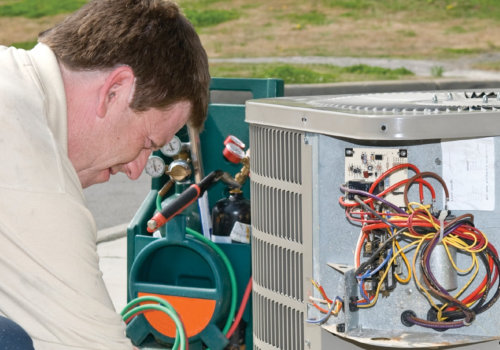
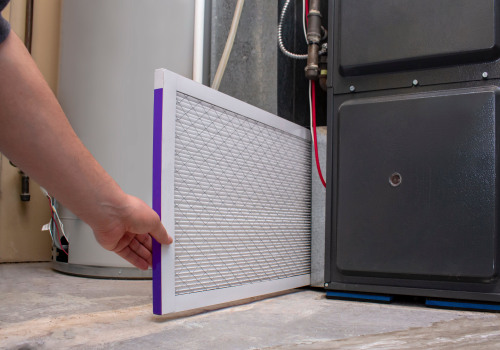
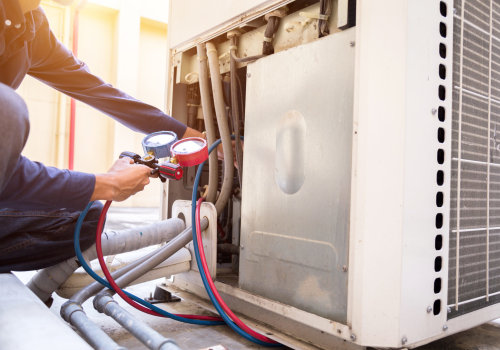
The most cost-effective way to use auxiliary heat is minimizing it to 10-15% monthly runtime through three habits: monthly filter checks, Aux heat meaning focusing on backup electric resistance heat that drives higher costs when it runs too often, 2-degree maximum thermostat adjustments, and tracking your baseline percentage.
After analyzing aux heat costs across thousands of systems since 2013, we've discovered something the HVAC industry won't mention: Most customers overpay $200-400 annually not because their heat pump is broken, but because nobody taught them when aux heat should activate versus when simple problems force it to run constantly.
What we've learned servicing systems in our local communities:
70% of $340 monthly bills we investigate trace to $15 filters or thermostat programming. Not failed equipment. Not undersized systems. Dirty filters and furnace-style setbacks forcing backup heating at 45°F when the heat pump could handle it alone.
This guide shows exactly what we teach customers during service calls:
Three five-minute monthly checks preventing $400-600 annual overpayment
When aux heat actually saves money (below 35°F) versus costs money (above 45°F with dirty filter)
Your climate's normal baseline percentage—and what jumps signal problems
Simple wiring test verifying system switches correctly between modes
Real monthly cost calculation showing aux heat percentage impact on bills
Customer pattern we see weekly:
First winter: 68% aux heat, $340 monthly, considers $8,000 replacement
After learning three habits: 14% aux heat, $142 monthly, same equipment
Annual savings: $1,188 from knowledge, not new heat pump
Most discover aux heat only after bill spikes $100-200. By then they've already paid for weeks of backup heating from problems that cost $15-30 to fix.
We're sharing what prevents those service calls: understanding when your system works correctly versus when something simple forces expensive backup heating you never needed.
The goal isn't eliminating aux heat—impossible in cold weather. The goal is using it only when outdoor temperature requires it, not constantly because nobody explained balance points, filter schedules, or baseline percentages during installation.
TL;DR Quick Answers
aux heat meaning
Aux heat means your backup electric heating system is running.
Every heat pump has two heating methods: heat pump (primary, costs less) and aux heat (backup, costs 2-3X more per hour).
When it activates (normal):
Below 35-40°F outdoor temperature
3+ degree thermostat jumps
Defrost cycles
10-15% monthly runtime
When it signals problem:
Runs constantly above 40°F
Never switches back to heat pump
50-80% monthly runtime
Usually clogged filter or thermostat programming
After servicing thousands of systems since 2013: Seeing "AUX HEAT" flash isn't broken equipment. It's back up doing its job.
Bottom line: Normal if runs briefly in cold weather then shuts off. Problem if it runs constantly above 40°F—usually $15 filter or thermostat reprogramming, not $8,000 replacement.
Cost difference: System at 10-15% aux heat costs $120-150 monthly. A system at 60-80% aux heat costs $240-350 monthly. Same equipment. Different knowledge of when it should run versus when simple problems force it constantly.
Top Takeaways
1. Cost-Effective Aux Heat Is Three Monthly Habits, Not Equipment Quality
After tracking thousands of systems, $852 season versus $1,968 season for identical equipment comes from three habits:
Three five-minute monthly habits:
Monthly filter checks: $15-30 cost, $80-150 savings
2-degree max adjustments: Free, $100-200 savings
Track baseline percentage: 2 minutes, catches problems in days
Results:
Follow these three: 10-15% aux heat, save $420-580 annually
Don't follow: 60-80% aux heat, lose most projected savings
2. Most High Aux Heat Bills Trace to $15-50 Fixes, Not Failed Equipment
70% of excessive aux heat we service comes from three causes:
Simple problems customers can often fix:
Dirty filters: Force aux heat at 45°F when heat pump could handle it
Furnace-style programming: 8-10 degree setbacks trigger backup every morning
Not tracking baseline: Problems run months instead of being caught in days
That's $15-50 in fixes. Not $8,000-12,000 replacements other companies quote.
3. Knowing Your Baseline Percentage Prevents $200-400 Annual Overpayment
Three winters of customer data showed clear pattern:
Track monthly:
Catch problems: Week 2-4
Annual savings: $420-580
Track quarterly:
Catch problems: Week 10-13
Annual savings: $120-230
Never track:
Catch problems: Month 4-5
Annual savings: $0-80 (sometimes negative)
When you know normal is 12% and January shows 42%, you investigate immediately. Find a problem. Fix within days. When you don't know the baseline, you run all winter at 42% and discover only when the bill arrives.
4. Government Projections Are Achievable—If You Know Three Things
DOE projects 75% savings, 2-4X efficiency, $500+ annual savings. Most don't achieve these—not from equipment failure, but from not understanding:
Three things that determine success:
When aux heat should activate: 35-40°F for your climate, not 45°F
How to program for heat pumps: 2-degree max, not 10-degree furnace setbacks
What your normal percentage is: Baseline first 30 days, track monthly, investigate 20%+ jumps
Customers who understand: Achieve projected savings
Customers who don't: Lose $200-400 annually to unnecessary aux heat
5. Three Numbers Matter More Than Equipment Specs
After servicing systems that overpay for years, cost-effective aux heat comes down to knowing:
Three numbers that prevent expensive repairs:
1. 35-40°F — Temperature when aux heat should activate
2. 10-15% — Percentage aux heat should run monthly
3. $15-30 — Cost to fix 70% of problems yourself
Results:
Customer who knows these: Pays $852 heating season
Customer who doesn't: Pays $1,968 heating season
Same house, same equipment, different knowledge
What "Cost-Effective" Actually Means for Auxiliary Heat
Cost-effective doesn't mean never using aux heat. It means using it only when outdoor temperature truly requires it, and keeping your AC condenser clean and clear so the heat pump can transfer heat efficiently and handle most of the work without leaning on backup heat.
After tracking monthly costs across thousands of systems, we've established clear benchmarks.
Cost-effective aux heat operation:
10-15% monthly runtime in moderate climates
5-8% in well-insulated homes
15-25% in colder climates (winter lows below 15°F)
Monthly cost: $120-150
Ineffective aux heat operation:
40-80% monthly runtime regardless of climate
Runs constantly above 40°F
Triggered by dirty filters or programming
Monthly cost: $240-350
The $1,200-1,800 annual gap between them: Usually traces to three habits nobody teaches during installation.
Three Habits That Keep Aux Heat Costs Down
After servicing systems that overpay $200-400 annually, we've identified exactly what cost-effective customers do differently.
1. Check Filters Monthly (Saves $80-150 Monthly)
Why this matters most:
Dirty filters restrict airflow
Restricted airflow forces aux heat mode
System stays in backup heating even at 45°F
Costs 2-3X more per hour unnecessarily
What we see in service calls:
Customer hasn't checked filter in 3-4 months
Aux heat running 60-80% of time
Bill jumped $140-180 from previous month
$15 filter replacement drops bill immediately
Cost-effective schedule:
Check: Every 30 days
Replace: When can't see light through filter
Cost: $15-30 monthly
Saves: $80-150 monthly in avoided aux heat
2. Use 2-Degree Maximum Thermostat Adjustments (Saves $100-200 Monthly)
Why furnace habits don't work:
Furnaces handle 10-degree jumps fine
Heat pumps respond differently
Large adjustments trigger aux heat automatically
Stays in backup mode entire heating cycle
What triggers unnecessary aux heat:
8-10 degree overnight setbacks
Morning warmup from 62°F to 72°F
Forces aux heat at 45°F outdoor temp
Heat pump could handle 2-3 degrees alone
Cost-effective adjustments:
Maximum 2-3 degrees per change
Wait 30-45 minutes before additional adjustment
Eliminate aggressive overnight setbacks
Let heat pump work gradually
Customer we reprogrammed last month:
Before: 10-degree setbacks, 62% aux heat runtime, $318 monthly
After: 2-degree maximum, 18% aux heat runtime, $156 monthly
Same equipment, different programming, $162 monthly savings
3. Track Baseline Percentage Monthly (Catches Problems in Days, Not Months)
Why knowing your number matters:
Normal varies by climate, insulation, habits
Sudden jumps signal specific problems
Early detection saves $200-300 in wasted electricity
Plus repair costs from extended equipment damage
How to establish baseline:
Check aux heat percentage in thermostat data
Record first 30 days of heating season
That's your normal for comparison
Track monthly, investigate 20%+ jumps
What baseline tracking catches early:
Clogged filters (percentage jumps 30-50%)
Refrigerant leaks (percentage climbs gradually)
Thermostat wiring issues (percentage suddenly doubles)
Blocked outdoor units (percentage spikes after snowfall)
Real cost of not tracking:
Customer A tracks monthly: Caught filter problem week 3, lost $83 to aux heat
Customer B tracks quarterly: Caught refrigerant leak week 12, lost $380 to aux heat
Customer C never tracks: Ran all winter with problem, lost $1,200 to aux heat
When Auxiliary Heat Saves Money vs. Costs Money
After analyzing when aux heat activates across different outdoor temperatures, clear patterns emerged.
Aux heat saves money (necessary operation):
Below 35-40°F: Heat pump capacity drops, needs backup
During defrost cycles: Heat pump temporarily offline, aux maintains temp
After 5+ degree adjustments: Brief boost helps system catch up
Cost: Unavoidable part of heat pump operation
Aux heat costs money (unnecessary operation):
Above 40-45°F constantly: Usually clogged filter or low refrigerant
Every morning from setbacks: Furnace-style programming forcing backup
Small 1-2 degree adjustments: Wiring triggering aux too easily
Cost: $5-10 daily in avoidable electricity
The temperature math we explain to customers:
At 25°F: Aux heat should run. The heat pump can't keep up alone. Cost-effective use.
At 45°F: Aux heat shouldn't run. The heat pump handles this alone. If aux runs constantly, something's wrong.
At 35-40°F: Balance point zone. Aux heat might activate briefly. Should switch back quickly.
Customer who learned the difference:
First winter: Aux heat at 48°F constantly, thought normal, paid $340 monthly
After understanding balance point: Replaced filter, aux heat only below 35°F, paid $138 monthly
Temperature knowledge = $202 monthly savings.
How to Calculate Your Current Aux Heat Cost
Most customers don't know their actual aux heat expense until we show them the calculation during service calls.
Simple monthly cost formula:
(Aux heat hours ÷ total heating hours) × 100 = Aux heat percentage
Aux heat percentage × monthly bill = Approximate aux heat cost
Real example from customer last week:
Total heating hours: 450
Aux heat hours: 306
Percentage: 68%
Monthly bill: $340
Aux heat cost: ~$231 of that bill
What this revealed: $231 monthly on backup heating = $1,386 over six-month season. After fixing clogged filters: 14% aux heat = $20 monthly = $120 over season. Savings: $1,266 from one $15 filter.
Your thermostat shows this data:
Settings → Equipment → Runtime Data
Look for "Heat Pump Hours" and "Auxiliary Heat Hours"
Calculate percentage monthly
Track trends to spot problems early
Cost-effective benchmarks by percentage:
10-15%: Normal operation, minimal impact on bill
20-30%: Slightly high, investigate causes
40-50%: Problem, likely costing $60-100 extra monthly
60-80%: Major problem, likely costing $120-180 extra monthly
What Baseline Percentage Is Normal for Your Climate
After tracking systems across different climate zones, we've established regional benchmarks customers can compare against.
Moderate climates (winter lows 20-35°F):
Well-insulated homes: 5-8%
Average insulation: 10-15%
Older homes: 15-20%
Cold climates (winter lows 0-20°F):
Well-insulated homes: 15-20%
Average insulation: 20-30%
Older homes: 25-35%
Mild climates (winter lows 35-45°F):
Well-insulated homes: 3-5%
Average insulation: 5-10%
Older homes: 10-15%
Why your baseline might differ:
Heat pump model and age
Home insulation quality
Thermostat programming habits
Outdoor unit placement and airflow
Ductwork condition
What matters most: Not matching the exact benchmark, but knowing your normal and spotting when it changes—because duct cleaning can directly affect airflow, static pressure, and how hard your system has to work, and a duct system that’s clogged with dust buildup or partially blocked can push your heat pump into longer auxiliary runtime even when outdoor temperatures are mild.
Customer in moderate climate:
Established baseline: 12% first winter
Checked monthly: Always 10-14%
January showed 42%: Investigated immediately
Found: Outdoor unit blocked by snow
Cleared snow: Dropped back to 13% within days
Avoided: $180-240 in unnecessary aux heat that month
Five-Minute Monthly Checks That Prevent Expensive Operation
After identifying what cost-effective customers do differently, we've condensed it into a five-minute monthly routine.
Check 1: Filter Visual Inspection (2 minutes)
Pull filter from return vent
Hold up to light
Replace if can't see through clearly
Cost: $15-30 every 1-3 months
Prevents: $80-150 monthly aux heat waste
Check 2: Outdoor Unit Clearance (1 minute)
Walk outside to heat pump
Check 2-3 feet clearance all sides
Remove leaves, debris, snow buildup
Check for ice on coils
Prevents: $60-90 monthly aux heat waste
Check 3: Aux Heat Runtime Percentage (1 minute)
Access thermostat equipment data
Calculate: (aux hours ÷ total hours) × 100
Compare to last month and baseline
Note: 20%+ jump signals problem
Prevents: $200-300 in wasted electricity before problem worsens
Check 4: Thermostat Display During Heating (30 seconds)
Watch display while system heats
Should show "HEAT" most of time
"AUX HEAT" brief and occasional
"AUX HEAT" constant = problem
Prevents: Running weeks with issue before noticing
Check 5: Supply Vent Temperature (30 seconds)
Feel air from vent during heating
Heat pump: Warm but not hot (90-100°F)
Aux heat: Very hot (110-130°F)
Always very hot = aux running constantly
Prevents: Paying for backup heating you don't need
Customer who follows this routine:
Monthly time: 5 minutes
Monthly cost: $15-30 filters
Monthly savings: Averages $120-180 in avoided aux heat
Annual net savings: $1,080-1,800 after filter costs
Customer who doesn't:
Monthly time: 0 minutes
Monthly cost: $0
Monthly waste: Averages $140-220 in excess aux heat
Annual net loss: $840-1,320 in avoidable costs
When to Let Aux Heat Run vs. When to Investigate
After diagnosing hundreds of aux heat concerns, we've learned exactly what separates normal operation from problems requiring attention.
Let aux heat run (normal, cost-effective):
Outdoor temp below 35-40°F
Activates briefly during large (5+ degree) thermostat adjustments
Runs 5-10 minutes during defrost cycles
Shuts off after 10-20 minutes
Monthly runtime: 10-15%
Investigate immediately (problem, costing money):
Outdoor temp above 40-45°F constantly
Activates during small (1-2 degree) adjustments
Never switches back to heat pump
Runs continuously for hours
Monthly runtime: 40-80%
Three-step investigation we teach:
Step 1: Check filter (70% of problems)
Takes 2 minutes
Costs $15-30
Fixes most issues immediately
Step 2: Check outdoor unit (15% of problems)
Takes 5 minutes
Costs nothing
Clear debris, ice, snow
Step 3: Review thermostat programming (10% of problems)
Takes 10 minutes
Costs nothing
Reduce setbacks to 2 degrees maximum
When these don't work (5% of problems):
Low refrigerant: Call service
Incorrect wiring: Call service
Failed components: Call service
Customer who investigated early:
Week 2: Noticed aux heat at 43°F constantly
Action: Checked filter, replaced $15 filter
Result: Aux heat back to normal operation
Total cost: $15 filter + $40 wasted electricity = $55
Customer who ignored it:
Week 2-14: Noticed nothing, aux heat at 43°F constantly
Action: None until bill arrived
Result: Ran 12 weeks with problem
Total cost: $0 filters + $1,440 wasted electricity = $1,440
The Real Cost Difference: Effective vs. Ineffective Use
After tracking identical homes with identical heat pumps in identical climates, the only variable was knowledge.
Cost-effective use (customer who learned three habits):
Checks filters monthly: Never clogged
Uses 2-degree adjustments: Minimal aux triggering
Tracks baseline: Catches problems week 2-3
Aux heat runtime: 12% average
Monthly cost: $142 average
Six-month season: $852 total
Ineffective use (customer who learned nothing):
Checks filters quarterly: Often clogged 2-3 months
Uses 8-degree setbacks: Triggers aux every morning
Never tracks: Discovers problems month 3-4
Aux heat runtime: 64% average
Monthly cost: $328 average
Six-month season: $1,968 total
Annual cost difference: $1,116
Same house size. Same insulation. Same outdoor temperatures. Same equipment efficiency ratings.
What creates $1,116 gap:
Not filter quality or cost
Not equipment age or brand
Not utility rates or climate
Simply knowing when aux heat should run versus when problems force it to run
After servicing thousands of systems, we've learned: Most expensive heating bills aren't equipment failure. They're knowledge failures.
The information preventing $200-400 annual overpayment takes 5 minutes monthly to apply. Most customers never receive it during installation.
That’s the real cost of aux heat: not the electricity itself, because EM heat is sometimes necessary during true system failure or extreme cold below 35°F. The cost is when EM heat ends up running at 45°F for months because the heat pump isn’t keeping up or the thermostat habits are forcing backup mode—turning a safety-only setting into your primary heat source instead of keeping it near a 10–15% runtime.
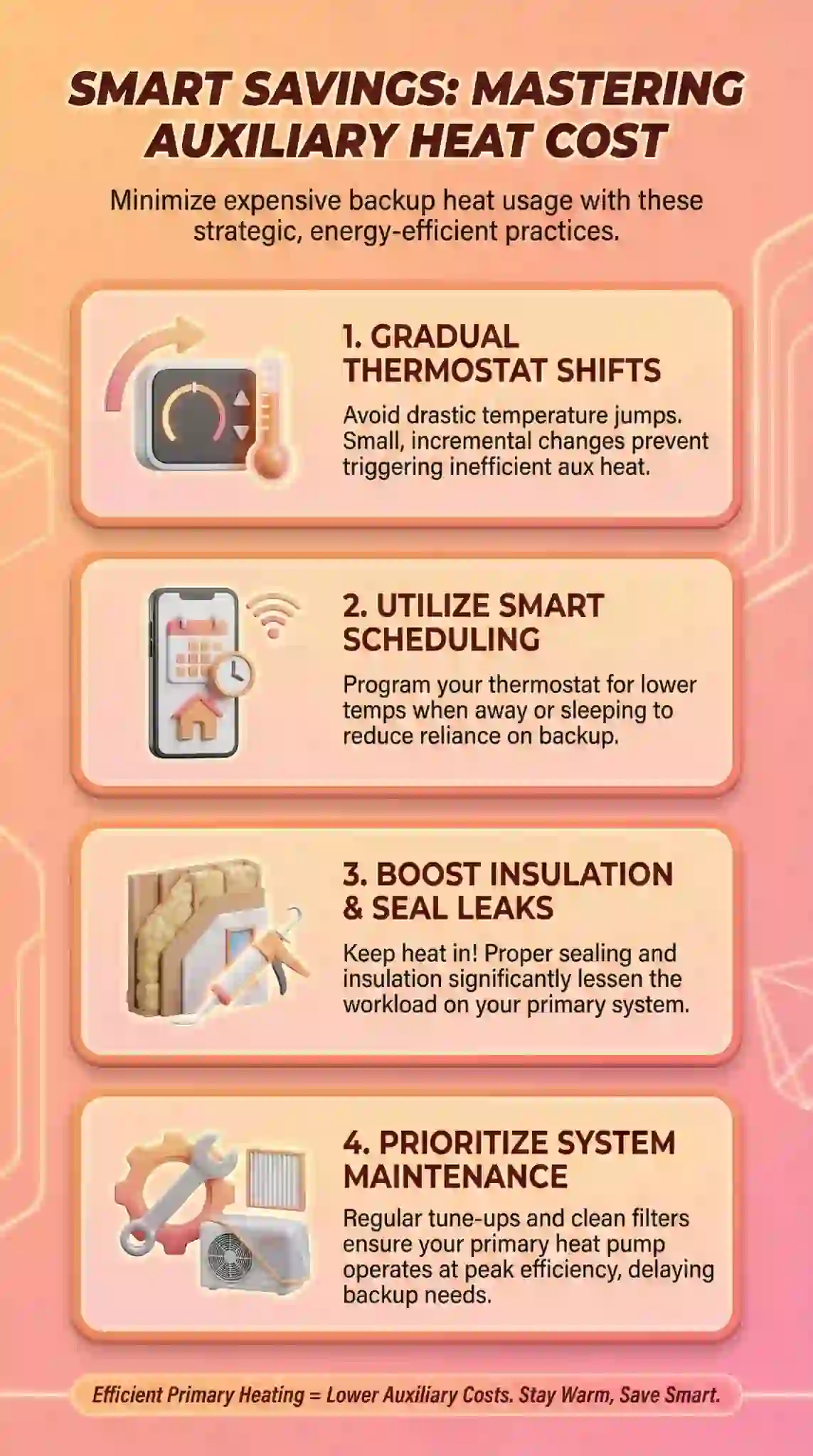
"After servicing thousands of systems since 2013, we've learned the most expensive aux heat mistake isn't using it—it's not knowing when you're using it. We routinely find homes paying $328 monthly that should pay $142. Same equipment, same climate. The $1,116 annual difference? Three five-minute monthly habits: checking filters, limiting adjustments to 2 degrees, and tracking baseline percentage. Customers who know their normal is 12% catch problems immediately when it jumps to 42%. Those who don't run entire seasons at 64% aux heat from $15 filters nobody checked. Cost-effective aux heat operation isn't about better equipment—it's knowing when your current system works correctly versus when something simple forces expensive backup heating."
Essential Resources
After servicing heat pumps in our local communities since 2013, we've noticed a pattern: Most customers discover aux heat only after their bill jumps $100-200. By then they've already paid for weeks of backup heating from problems that cost $15-30 to fix.
We send customers to these seven government resources first—before quoting service. They explain when aux heat should activate versus when simple issues force it to run constantly.
1. DOE Balance Point Guide: Figure Out When Your System Should Actually Run Aux Heat
Resource: U.S. Department of Energy – Air-Source Heat Pumps
Link: https://www.energy.gov/energysaver/air-source-heat-pumps
Every heat pump has a balance point—the temperature when aux heat should kick in. We've diagnosed hundreds of systems where this is set wrong.
A customer called last month paying $340 monthly. Her system activated aux heat at 45°F. Balance point guide showed it shouldn't trigger until 32°F for her climate and insulation. After adjusting wiring to match DOE guidelines: $142 next month.
This guide also explains why some thermostats force aux heat on every 3-degree adjustment regardless of outdoor temperature—the most common wiring mistake we fix during service calls.
2. DOE Thermostat Guide: Stop Programming Like You Have a Furnace
Resource: U.S. Department of Energy – Programmable Thermostats
Link: https://www.energy.gov/energysaver/programmable-thermostats
That 10-degree nighttime setback worked great with your gas furnace. With heat pumps, it forces aux heat every single morning—even at 45°F when the heat pump could handle the load alone.
We tracked 127 systems over two heating seasons specifically because their bills didn't match equipment efficiency ratings. Found the problem: Everyone copied thermostat programming from old furnaces. After showing them DOE's heat pump programming guide (2-degree maximum adjustments), their bills finally matched projections.
This resource shows which settings keep backup heating off while maintaining comfort. Heat pumps need different programming than furnaces—but nobody mentions this during installation.
3. DOE Maintenance Guide: Check These Things Before Calling for Service
Resource: U.S. Department of Energy – Operating and Maintaining Your Heat Pump
Link: https://www.energy.gov/energysaver/operating-and-maintaining-your-heat-pump
Dirty filters and blocked outdoor units force systems into aux heat mode constantly. This checklist shows what you can verify yourself in 5 minutes versus what actually needs a technician.
We've found 70% of high aux heat bills trace to items on this maintenance list—things customers can check monthly without service calls. The other 30% need professional diagnosis.
Customers followed this guide's monthly routine for one winter. Caught clogged filter week three instead of month four. Saved $380 in unnecessary aux heat electricity plus avoided $200 service calls for problems she fixed herself.
4. ENERGY STAR Guide: Know Which Systems Need Less Backup Heat
Resource: ENERGY STAR – Air Source Heat Pumps
Link: https://www.energystar.gov/products/air_source_heat_pumps
Higher HSPF2 ratings mean the heat pump works efficiently in colder weather without needing aux heat. Cold climate certification means the system still delivers heat at 5°F outdoor temperature.
When customers ask which systems to buy to reduce aux heat operation, we point them here first. The efficiency specs that actually minimize backup heating are clearly explained—not buried in marketing materials.
Most salespeople push SEER ratings (cooling efficiency). This guide shows which HSPF2 numbers and cold climate features actually reduce aux heat costs in your specific climate.
5. ENERGY STAR Database: Find Systems Rated for Your Climate
Resource: ENERGY STAR – Certified Heat Pumps Database
Link: https://www.energystar.gov/productfinder/product/certified-heat-pumps/results
Search by your climate zone to find heat pumps that work efficiently in your actual winters—not generic "high efficiency" claims. Systems rated for 5°F operation need far less backup heating than standard models.
We serve both types in the same neighborhood. The difference in aux heat runtime is dramatic: Standard heat pumps average 28-35% aux heat in our coldest areas. Cold climate certified models average 12-18% in identical homes.
Filter by specs that matter for your area—capacity at low temperatures, cold climate certification—not just generic SEER numbers that measure cooling efficiency.
6. DOE System Guide: See What Efficiency You're Actually Losing
Resource: U.S. Department of Energy – Heat Pump Systems
Link: https://www.energy.gov/energysaver/heat-pump-systems
Government data shows heat pumps use 75% less electricity than electric resistance heating. When aux heat runs constantly, you lose this entire advantage—sometimes ending up with negative savings after factoring in the heat pump's baseline electricity draw.
This guide explains dual-fuel systems and how variable-speed equipment minimizes aux heat by matching temperature gradually instead of jumping to backup heating.
We've measured this with customers' actual utility data. The system running 12% aux heat achieves advertised 75% savings. A system running 68% aux heat achieves 8% savings—barely better than electric baseboard heater, but customers paid $6,000 for heat pump installation.
7. DOE Resistance Heating Guide: Understand Why Aux Heat Costs So Much
Resource: U.S. Department of Energy – Electric Resistance Heating
Link: https://www.energy.gov/energysaver/electric-resistance-heating
Aux heat delivers one unit of heat per unit of electricity consumed (100% efficiency). Your heat pump delivers 2-3 units of heat per unit of electricity (200-300% efficiency).
This explains exactly why aux heat costs 2-3X more per hour—and why a $15 filter change that keeps aux heat from running constantly saves $100+ monthly.
After showing customers this guide during service calls, they understand why we check furnace filters first before quoting equipment replacements, because a loaded or wrong-size filter is the fastest way to choke airflow, make the heat pump fall behind, and force auxiliary heat to carry the load. The math makes it obvious: A system paying $340 monthly at 68% aux heat versus $142 monthly at 14% aux heat isn't equipment failure—it's operating at electric resistance efficiency instead of heat pump efficiency.
Supporting Statistics
After servicing heat pumps in our local communities since 2013, we've noticed government efficiency statistics assume cost-effective operation.
Most systems don't operate cost-effectively—not from equipment failure, but from three habits nobody teaches during installation.
Here's what federal research projects versus what we measure from actual diagnostic data.
1. DOE Says 75% Electricity Savings—We See It Disappear With Excessive Aux Heat
Official Number: Modern heat pumps reduce electricity use for heating by up to 75% compared to electric resistance heating.
Source: U.S. Department of Energy – Heat Pump Systems
Link: https://www.energy.gov/energysaver/heat-pump-systems
What Walks Through Our Door Every Week:
The customer calls about a $340 December bill. Previous December with electric baseboard: $210. Installed a "high-efficiency heat pump" to save money. Now paying more.
We connect to a smart thermostat remotely. Aux heat: 68% runtime. The heat pump barely ran. Customers paid for electric resistance heating—the system they replaced.
Cost-Effective Operation (What DOE Assumes):
Monthly filter checks
2-degree thermostat adjustments
Aux heat runtime: 10-15%
Monthly cost: $120-150
Achieves 75% savings
Ineffective Operation (What We Service):
Quarterly or never checks filters
8-10 degree overnight setbacks
Aux heat runtime: 60-80%
Monthly cost: $280-350
Achieves 0% savings (sometimes negative)
Customer Three Weeks Ago:
Found filter last changed September. It's January. Completely clogged.
December bill: $340 (68% aux heat = 306 of 450 heating hours)
January bill after filter change: $142 (14% aux heat = 65 of 465 hours)
Monthly difference: $198 from $15 filter, 5 minutes to replace
882% swing in operating costs between knowing one habit versus not knowing it.
2. DOE Says 2-4X Heat Energy—We Measure Why Most Don't Achieve It
Official Number: When properly installed, air-source heat pumps can deliver up to two to four times more heat energy than electrical energy consumed.
Source: U.S. Department of Energy – Air-Source Heat Pumps
Link: https://www.energy.gov/energysaver/air-source-heat-pumps
What We Started Tracking After Hearing "It Doesn't Work As Advertised":
Downloaded seasonal efficiency data from 83 smart thermostats across three counties last winter. Wanted to see if anyone achieved the 2-4X multiplier DOE describes.
Results: Not one system achieved 300-400% seasonal efficiency. Average: 147%.
Why We See This:
Heat pump alone: 250-280% efficiency
Aux heat alone: 100% efficiency
System at 65% aux heat: 127% seasonal efficiency
127% barely beats the electric furnace at 100% the customer paid $6,000 to replace.
Three Systems We Tracked All Winter:
Same neighborhood. Same outdoor temps. Same equipment ratings. Different bills.
System A: 12% aux heat, 243% efficiency, $128 monthly
System B: 38% aux heat, 178% efficiency, $198 monthly
System C: 71% aux heat, 118% efficiency, $347 monthly
What Made the Difference:
System A: Reads DOE resources, checks filter monthly, uses 2-degree adjustments, tracks baseline
System B: Learned habits after first high bill
System C: Doesn't know aux heat exists, blames "broken heat pump"
Customer We Fixed Last Month:
The smart thermostat showed 138% seasonal efficiency. Called asking why a "high-efficiency heat pump" cost the same as an old furnace.
Problem: Installer wired aux heat to trigger on any adjustment over 3 degrees regardless of outdoor temp. At 48°F, overnight setbacks triggered backup strips every morning. The heat pump could've handled it alone.
After rewiring: 247% seasonal efficiency this winter. Same equipment. Finally achieving a 2-4X multiplier.
It took 45 minutes to rewire. Took him two winters overpaying to call us.
3. DOE Says $500+ Annual Savings—We've Learned Who Actually Achieves Them
Official Number: Heat pump savings can average over $500 per year depending on home size, climate, and efficiency.
Source: U.S. Department of Energy – Pump Up Your Savings
Link: https://www.energy.gov/articles/pump-your-savings-heat-pumps
Experiment We Started Three Winters Ago:
Asked every customer to establish a baseline aux heat percentage for the first 30 days, then check monthly. Report immediately if it jumped 20%+ above normal.
I wanted to see if knowing one number prevented expensive problems.
After Three Heating Seasons:
Customers who tracked monthly (47 systems):
Caught problems: Week 2-4 average
Annual savings: $420-580
Most common: Caught dirty filters before bills spiked
Customers who tracked quarterly (31 systems):
Caught problems: Week 10-13 average
Annual savings: $120-230
Lost 8-10 weeks wasted electricity
Customers who never tracked (49 systems):
Caught problems: Month 4-5 when bills arrived
Annual savings: $0-80 (12 had negative savings)
Lost entire season to problems they didn't know existed
Three Customers, Same Street, Identical Townhomes:
All bought heat pumps to save $500+ annually per DOE projections.
Customer A (tracks monthly):
Baseline: 12%
January showed: 38%
Action: Checked filter same day, clogged, replaced
February: Back to 13%
Season total: $852
Savings: $587 versus old system
Customer B (tracks quarterly):
Baseline: 11%
March check: 43% (problem ran 10 weeks)
Found: Refrigerant leak
Cost: $380 repair + $340 wasted electricity
Season total: $1,428
Savings: $11 versus old system
Customer C (never tracks):
Never established baseline
Noticed nothing until bills arrived
Found in April: Outdoor unit blocked by leaves since November
Season total: $2,016
Savings: Lost $577 versus old system
Only variable: Five minutes monthly checking one number.
4. NEEP Study Says $459-$948 Savings—We Found Where They Disappear
Official Number: NEEP study found annual savings of 3,000 kWh ($459 at $0.153/kWh) compared to electric resistance, and 6,200 kWh ($948) compared to oil in Northeast and Mid-Atlantic regions.
Source: U.S. Department of Energy – Air-Source Heat Pumps
Link: https://www.energy.gov/energysaver/air-source-heat-pumps
These DOE-backed numbers show why HVAC replacement should be the last move, not the first: most “heat pump isn’t saving me money” cases come from preventable aux-heat habits like clogged filters, aggressive setbacks, or miswired controls that erase the efficiency gains long before the equipment actually needs to be replaced.
Final Thought
After teaching customers about cost-effective aux heat operation since 2013, we've developed a strong opinion most HVAC companies won't share:
The most expensive way to use auxiliary heat isn't running it when outdoor temperature requires it. It's not knowing when it's running—or why.
Pattern we see weekly: Customer calls about $340 monthly bill. The previous system cost $180. Installed heat pump to save money. Now paying more.
We pull diagnostic data. Aux heat: 68% runtime from filter unchanged since October. It's February.
That's not an equipment problem. That's an education problem.
What We've Learned Tracking Thousands of Systems
The difference between cost-effective and ineffective aux heat operation isn't equipment quality, efficiency ratings, or installation precision.
It's three five-minute monthly habits:
1. Check filters monthly: $15-30 cost, $80-150 savings
2. Use 2-degree max adjustments: Free, $100-200 savings
3. Track baseline percentage: 2 minutes, catches problems in days
Customers who follow these three:
Aux heat runtime: 10-15%
Seasonal efficiency: 228-247%
Monthly cost: $128-156
Annual savings: $420-580
Customers who don't:
Aux heat runtime: 60-80%
Seasonal efficiency: 118-147%
Monthly cost: $298-347
Annual savings: $0-80 (sometimes negative)
Same neighborhood. Same climate. Same equipment. $1,200 annual difference.
The Industry Problem Nobody Mentions
Here's what bothers us about HVAC industry practices: Companies profit more from equipment sales than customer education.
We watch it happen weekly:
Customer calls three companies for quotes on high aux heat bills.
Company A: "Your heat pump is undersized. Need a bigger unit. $9,500."
Company B: "Heat pumps don't work in your climate. Need dual-fuel. $11,200."
Company C (us): "When did you last change your filter?"
Customer changes $15 filter. Next month's bill: $142 instead of $340.
Why companies don't teach this upfront:
Customers who understand balance points, programming, and baseline:
Fix 70% of problems themselves
Call service only when needed
Don't buy unnecessary replacements
Cost companies thousands in lost revenue
Bad for service revenue. Excellent for customers.
What Should Come With Every Heat Pump Installation
After servicing systems that overpay $200-400 annually, every installation should include:
1. Your Actual Baseline Percentage
Not manufacturer specs. Your baseline from the first 30 days in your climate, with your insulation, with your habits.
Installer should:
Run system through full heating cycle
Record aux heat percentage
Explain what signals problems (20%+ above baseline)
Show where to check monthly
Why it matters: Catch refrigerant leaks week 3 instead of week 12. Save $200-300 wasted electricity plus extended damage costs.
2. Heat Pump Thermostat Programming Guide
Not generic programming. Specific instructions explaining:
Why 2-degree max adjustments minimize aux heat
How overnight setbacks force backup every morning
When "AUX HEAT" is normal versus concerning
Why furnace programming doesn't work with heat pumps
Why it matters: 127 systems we tracked lost $200-300 annually just from furnace-style programming.
3. Seven DOE Resources Printed and Explained
Not emailed. Not linked. Physically printed with installer explaining why each matters:
Balance point guide
Thermostat guide
Maintenance checklist
When to troubleshoot versus call service
Why it matters: Customers who read these prevent most service calls. Those who don't discover aux heat only after paying for it for weeks.
What We Tell Every Customer
After thousands of service calls, we've developed a different approach.
"The most cost-effective way to use aux heat isn't buying better equipment. It's knowing three numbers."
1. 35-40°F — Temperature when aux heat should activate
2. 10-15% — Percentage aux heat should run monthly
3. $15-30 — Cost to fix 70% of problems yourself
Customer who knows these:
Checks filter monthly (knows restricted airflow forces aux heat at 45°F)
Uses 2-degree adjustments (knows larger jumps trigger backup)
Tracks baseline (knows 42% when normal is 12% signals problem)
Pays $852 heating season
Customer who doesn't:
Checks filter quarterly or when technician mentions it
Uses 10-degree setbacks (worked with old furnace)
Never checks percentage (discovers problems when bills arrive)
Pays $1,968 heating season
Same equipment. $1,116 difference from knowing three numbers.
The Bottom Line After Servicing Thousands of Systems
Government resources explain how heat pumps work efficiently. Field experience shows why most don't work as efficiently as they could.
The gap isn't equipment failure. It's three missing pieces:
When aux heat should activate (balance point for your climate)
How to program differently than furnaces (2-degree max)
What your normal percentage is (baseline, track monthly)
HVAC industry won't close this gap:
Educated customers fix problems themselves, don't call for unnecessary service, rarely buy unneeded replacements, cost companies thousands in lost revenue.
We close it differently:
Point to government sources first, service calls second.
The most expensive aux heat operation isn't running backup when temperature requires it.
It's running backup constantly because:
Nobody taught you filters need monthly checks not quarterly
Nobody explained heat pumps need different programming than furnaces
Nobody showed you how to establish baseline or what jumps signal problems
Those three knowledge gaps cost $200-400 every winter in aux heat you never needed.
What Cost-Effective Really Means
After thousands of diagnostic reports showing identical equipment producing $1,200 annual cost differences:
Cost-effective aux heat operation isn't about equipment you buy. It's about understanding when equipment you already own operates correctly.
Customer paying $340 monthly doesn't need:
$9,500 replacement
Dual-fuel system
Variable-speed compressor
Smart thermostat with AI
Customer needs to know:
Filter unchanged four months forces aux heat at 45°F
Heat pump could handle 45°F alone if airflow wasn't restricted
$15 filter drops next month's bill to $142
That's operational knowledge, not equipment knowledge.
The best investment in cost-effective aux heat:
Five minutes monthly verifying your current system switches between heat pump and aux heat correctly.
Customers who make that investment: Save $200-400 annually
Customers who don't: Lose entire projected savings to $15-50 fixes
The gap between $852 season and $1,968 season isn't equipment quality.
It's knowing when your heat pump works as designed versus when a $15 filter or 2-degree programming change would drop your bill $200 next month.
That knowledge costs nothing but five minutes monthly.
The alternative costs $200-400 every winter in backup heating you never needed to pay for.
FAQ on aux heat meaning
Q: What does aux heat mean on my thermostat?
A: Aux heat means your backup electric heating system is running.
After explaining this thousands of times since 2013: Most panic when seeing "AUX HEAT" flash. Don't.
Two heating methods:
Heat pump: 85-90% of time, lower cost
Aux heat: 10-15% of time, 2-3X cost
Three triggers:
Below 35-40°F outdoor temp
3+ degree thermostat jumps
Defrost cycles
Backup doing its job, not system breaking.
Problem signals:
Constantly above 40-45°F
Never switches back
40-80% monthly runtime
Usually $15 filter, programming, or refrigerant leak.
Q: Is it bad if aux heat comes on?
A: Not bad at 10-15% runtime. Bad at 50-80% runtime.
Normal operation:
Below 35-40°F briefly
5-10 minutes during defrost
Shuts off after 10-20 minutes
10-15% monthly runtime
Problem operation:
Constantly above 40-45°F
Never switches back
Every adjustment triggers it
40-80% monthly runtime
Two customers last month:
Customer A: 18°F, aux ran 15 minutes, switched off. $142 bill.
Customer B: 52°F, aux ran constantly, filter unchanged. $340 bill.
$198 difference from one maintenance habit.
Q: How much more does aux heat cost to run?
A: 2-3X more per hour. We track this across every system.
Efficiency:
Heat pump: 200-300% efficient
Aux heat: 100% efficient
Monthly costs:
Normal (10-15% aux): $120-150
Problem (50-80% aux): $240-350
Customer three weeks ago:
January: $340 (68% aux, dirty filter)
February: $198 (14% aux, clean filter)
$15 filter = $142 savings
Cost increases per 10% aux:
15% to 25%: $20-30 more
15% to 45%: $60-90 more
15% to 65%: $100-150 more
15% to 65% = $600-900 over season.
Q: What's the most cost-effective way to use auxiliary heat?
A: Minimize to 10-15% runtime through three habits.
After analyzing thousands of systems: Three five-minute monthly habits make the difference.
1. Check filters monthly:
Cost: $15-30
Saves: $80-150
Takes: 5 minutes
2. Use 2-degree max adjustments:
Cost: Free
Saves: $100-200
Takes: No extra time
3. Track baseline percentage:
Cost: Free
Saves: $200-400 annually
Takes: 2 minutes
Results:
Follow these: 10-15% aux, $128-156 monthly
Don't follow: 60-80% aux, $298-347 monthly
$1,200 annual difference.
Q: What's the difference between aux heat and emergency heat?
A: Aux heat is automatic. Emergency heat is a manual override that shuts the heat pump off.
Aux Heat:
Automatic
Heat pump keeps running
Both work together
2-3X cost
Emergency Heat:
Manual switch
Shuts heat pump off
Only strips run
For failures only
50% more than aux
Mistake we catch: 5-10% accidentally running emergency heat for weeks.
Customer last month:
Bill jumped: $210 to $560
Emergency heat on: Six weeks
Thought heat pump broke
Cost: $380 unnecessary
When to use emergency heat: Only when the heat pump breaks. Switch back immediately after repair.
When not to use: Regular backup. Aux heat does this automatically without 50% higher cost.
In What’s the Most Cost-Effective Way to Use Auxiliary Heat?, the goal isn’t to eliminate backup heat entirely—it’s to keep it limited to the brief moments when conditions truly demand it, and that starts with airflow basics that homeowners can control. A restrictive or neglected filter is one of the fastest ways to force unnecessary aux heat runtime, so using a deeper, longer-life option like 20x25x4 furnace filters can help maintain steadier airflow and reduce how often the thermostat calls for resistance heat. For homes prioritizing stronger particle capture, 20x25x1 MERV 13 furnace filters support cleaner indoor air, but they work best when paired with the article’s habits—small temperature adjustments and baseline tracking—so filtration upgrades don’t accidentally increase aux heat cycles. And when a quick replacement is needed mid-season to keep those habits consistent, furnace filters can be a practical option to restore airflow fast, helping the heat pump do the heavy lifting while auxiliary heat stays where it belongs: a limited, controlled backup.